The Physical Integrity of European Fired Earth
Across central and southern Europe, ceramic manufacturing represents centuries of localized geology. True ceramic connoisseurship begins with tactile examination. The tourist strips of Florence, Lisbon, and Seville are submerged in slip-cast, machine-printed ceramics imported from non-European factories, masked behind glossy regional motifs. True earthenware, stoneware, and porcelain reflect distinct weights, localized firing temperatures, and artisan hand-painting that can be verified through specific physical markers.
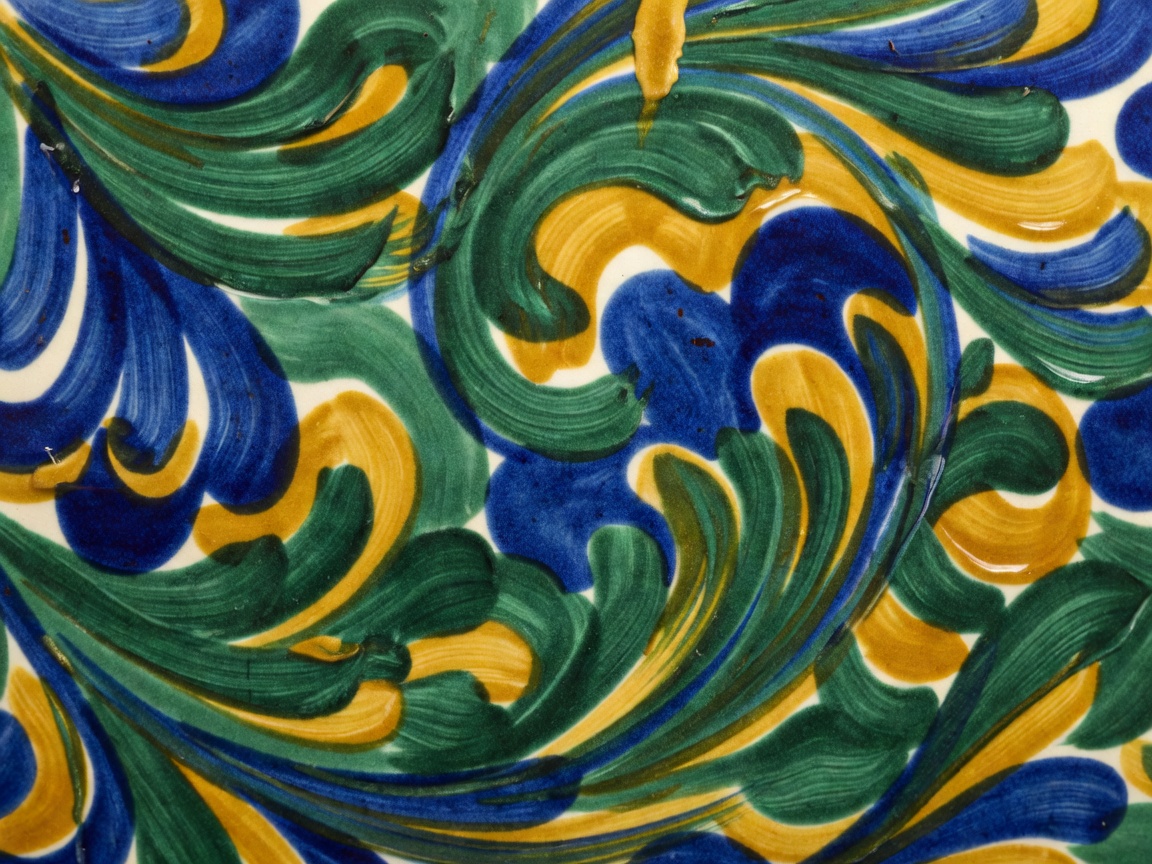
Mineral pigment variations on Deruta tin-glaze terracotta, showing individual brushwork strokes.
Hallmark Centers of European Ceramic Craft
Deruta Majolica (Umbria, Italy)
Practiced since the 13th century, Deruta majolica relies on local clay thrown by hand and coated with a milky opaque tin oxide glaze. Mineral oxides—copper green, antimony yellow, and cobalt blue—are brushed directly onto the unfired raw glaze before a second kiln cycle fuses them together.
Royal Delft Earthenware (Delft, Netherlands)
At De Porceleyne Fles, the sole remaining 17th-century manufacturer in Delft, artisans paint intricate blue decorations using black cobalt oxide on clay bisque, which turns vivid royal blue only after final high-temperature glaze firing.
Caldas da Rainha Faience (Portugal)
Epitomized by the 19th-century workshop founded by Rafael Bordallo Pinheiro, this Portuguese tradition celebrates naturalist and satirical trompe-l'œil relief work, featuring cabbage leaves, swallows, and shellfish coated in luminous, glassy glazes.
Westerwald Salt-Glaze (Rhineland, Germany)
Characterized by dense gray stoneware adorned with cobalt blue patterns, Westerwald pottery is fired at upwards of 1200°C. Common rock salt shoveled into the kiln chamber vaporizes, creating a durable, non-porous orange-peel textured glaze.
Diagnostic Matrix: Authentic Kiln & Studio Marks
To distinguish between genuine studio firings and mass-market reproductions, collectors must examine backstamps, underside unglazed foot rings, and brushwork consistency.
| Region / Material | Diagnostic Mark / Stamp | Underside Base Characteristics | Common Counterfeit Indicator |
|---|---|---|---|
| Deruta Majolica | Handwritten "Dipinto a Mano" with studio initials | Unglazed coarse terracotta foot rim with visible turning rings | Perfect flat smooth bottom with stamped rubber ink logo |
| Royal Delft | Jar monogram, 'TL' painter initials, year code | Slightly porous off-white foot with subtle tripod kiln stilt scars | Smooth transfer decal without raised hand-painted line depth |
| Murano Blown Glass | "Vetro Artistico Murano" holographic label | Hand-ground or rough circular pontil scar from iron blowpipe | Uniform molded seam line down the sides of the glass |
| Westerwald Stoneware | Impressed studio emblem or potter's monogram punch | Dark gray vitrified unglazed surface, cool and rock-hard | Painted brown plaster interior that absorbs moisture easily |
Verifying Venetian Glass in the Murano Lagoon
The island of Murano in the Venetian lagoon has held an unbroken glassmaking monopoly since 1291, when the Venetian Republic relocated furnaces to isolate fire hazards. Today, the market is severely diluted with industrial glass. To safeguard authenticity, travelers should observe three fundamental physical properties:
- The Pontil Mark: During hand-shaping, the glassblower holds the vessel via a solid iron rod (the punty). When cut away, this leaves a jagged or hand-ground depression on the base. Seamless, flat bases indicate factory press molds.
- Weight and Thermal Conductivity: True Venetian soda glass feels remarkably light and warm in comparison to heavy lead crystal. Its brilliance stems from silica purity and soda ash, not metallic weight.
- Pigment Integration: Colors in authentic Murano pieces are mineral oxides melted directly inside the furnace batch (such as gold leaf, cobalt, or copper). Fake specimens often feature painted surface coatings that scratch under modest pressure.
Packing and Transporting Fragile Ceramics
Never rely on carrier-bag wrapping for air transit. Reputable historic workshops provide bonded international shipping with full insurance. If carrying items in personal baggage, pack the hollow interiors with tightly balled acid-free tissue paper, wrap the exterior in several inches of corrugated cardboard or bubble wrap, and stow the parcel squarely in your overhead carry-on rather than checked baggage.
Continue exploring artisanal materials through our guides on Handwoven Linens & Loom Traditions and Customs Regulations & Workshop Etiquette.